


When most homeowners think about a new roof, they immediately focus on the “visible” part: the shingles. They spend hours debating between GAF Timberline HDZ in Hickory or Owens Corning Duration in Estate Gray. While the color and brand of your shingles are vital for curb appeal and surface protection, the true strength of your home’s defense lies beneath the surface.
In the Midwest—where we face heavy snow loads in Wisconsin, high winds in Indiana, and unpredictable storms in Illinois—the structural integrity of your roof decking is what actually keeps your family safe.
At Optimal Home Improvement, we believe in “Roofing Done Right,” which means we never just cover up a problem. In this guide, we’ll dive deep into the foundation of your roof: the decking.
Table of Contents
- What is Roof Decking and Why Does It Matter?
- Signs of a Failing Foundation: Rot, Sagging, and Holes
- The Danger of “Nail-Overs” and Hidden Damage
- Case Study: Addressing Extreme Decking Deterioration
- How Structural Integrity Impacts Your Manufacturer Warranty
- The Optimal Process: Ensuring a Solid Foundation for 2026
1. What is Roof Decking and Why Does It Matter?

Roof decking, also known as sheathing, is the layer of wooden boards (typically plywood or OSB) that are attached to your home’s rafters or trusses. Think of it as the “skin” over the skeleton of your house.
The decking serves two primary purposes:
- Structural Support: It provides the flat surface necessary to install underlayment and shingles.
- Nail-Holding Power: The shingles are only as secure as the wood they are nailed into. If the wood is soft or rotted, the nails won’t hold, making your roof vulnerable to shingle blow-offs during high winds.
2. Signs of a Failing Foundation: Rot, Sagging, and Holes
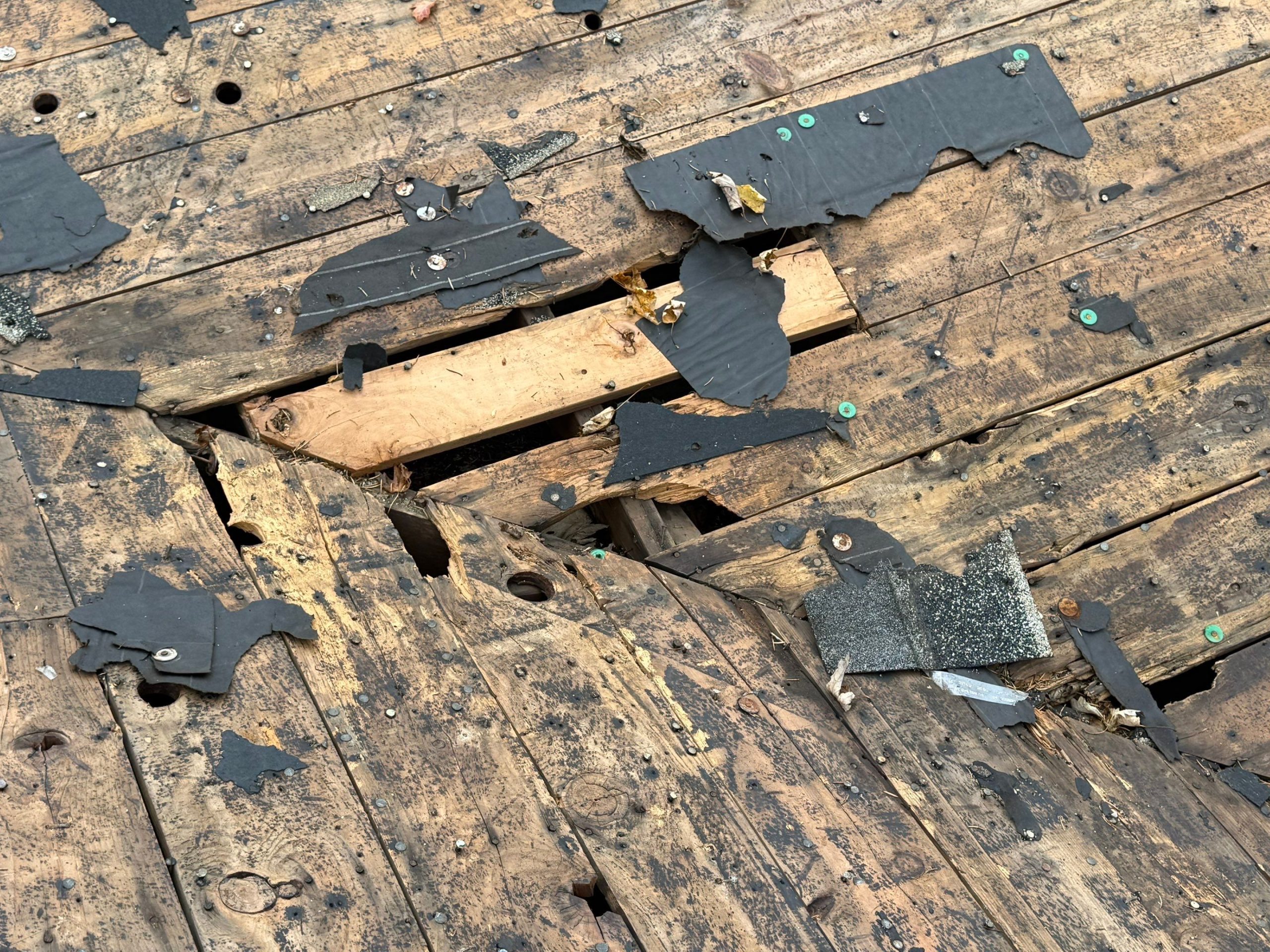
Many homeowners assume that if they don’t see water dripping from the ceiling, their roof foundation is fine. However, structural damage often starts silently.
Common signs of decking failure include:
- Wavy or Sagging Roofline: If you look at your roof from the street and see “dips” or waves, it’s a sign that the decking boards have weakened and are bowing under the weight of the shingles.
- Internal Attic Moisture: Dark spots on the wood in your attic, or the smell of mildew, indicate that water has bypassed the shingles and is soaking into the decking.
- Spongy Feel: When our technicians perform an inspection and feel “give” under their feet, it’s an immediate red flag that the structural integrity is compromised.
3. The Danger of “Nail-Overs” and Hidden Damage
One of the biggest mistakes a roofing company can make is performing a “layer-over” or a fast “tear-off” without inspecting the wood. Some contractors will simply nail new shingles over old ones to save time.
This is a dangerous practice. If the underlying wood is rotted, you are essentially pinning a heavy new weight (the shingles) onto a crumbling foundation. Eventually, the weight becomes too much, or a storm tears the shingles away because the nails had nothing solid to grip.
4. Case Study: Addressing Extreme Decking Deterioration
In our recent projects—such as the one we encountered in Cedar Lake—we stripped away the old shingles to reveal a homeowner’s worst nightmare: large holes and widespread rot in the original wood.
As seen in the technical photos from our site inspections, significant portions of the wood had literally crumbled away. If we had simply ignored this and shingled over it, the roof would have failed within a year. Instead, our team performed a full structural restoration, replacing the compromised boards with high-quality, weather-rated plywood to create a safe, stable base for the new GAF system.
5. How Structural Integrity Impacts Your Manufacturer Warranty
This is the part many homeowners miss: Manufacturer warranties (like those from GAF or Owens Corning) are often voided if the shingles are installed over compromised decking.
Manufacturers require a “clean, dry, and structurally sound” deck for their warranties to be valid. If your roof fails because the nails pulled out of rotted wood, the manufacturer will not cover the cost of the shingles. By choosing a contractor like Optimal Home Improvement that insists on decking repair, you are actually protecting your long-term financial investment and ensuring your warranty remains fully intact.
6. The Optimal Process: Ensuring a Solid Foundation for 2026
Our process is built on transparency and technical excellence. When we arrive at your home in Orland Park, Dyer, or Naperville, we don’t just look at the shingles.
- Full Tear-Off: We remove all old materials down to the bare wood.
- Decking Inspection: We inspect every square inch of the sheathing for rot, mold, or “delamination” (where the layers of wood peel apart).
- Structural Repair: We replace any damaged wood immediately, ensuring the “skeleton” of your roof is as strong as the day it was built.
- Premium Protection: Only after the foundation is perfect do we install the ice and water shields, underlayment, and your choice of premium shingles.
A roof is a 20-to-50-year investment. Don’t let a beautiful shingle color hide a dangerous foundation. Whether you are dealing with storm damage or simply an aging home, let the experts at Optimal ensure your home is protected from the inside out.